Summary: Predictive analytics is transforming how clinical trials select sites and enroll patients by replacing assumptions with evidence. When combined with RPA and AI in Healthcare and robotic process automation healthcare, sponsors and CROs gain clearer visibility into site performance, enrollment risk and operational readiness. This approach supports faster study starts, better patient diversity and predictable timelines without disrupting existing systems.
Clinical trial success depends heavily on two variables: site selection and patient enrollment. When either underperforms, timelines slip, costs rise and teams scramble to recover momentum. Data already exists across CTMS EDC EMRs and operational systems yet teams rarely convert it into foresight. Predictive analytics addresses this gap by transforming historical and real time data into actionable intelligence. When aligned with robotic process automation healthcare, organizations streamline execution while analytics guides decision making with precision.
Why Site Selection and Enrollment Remain High Risk Areas?
Before the trial of the first patient, the trials tend to come to a halt. Site feasibility questionnaires are based on self-reported estimates. Historical performance is in isolated systems. The access to patients in the regions changes more rapidly than the protocols.
When sponsors use non-evidence-based site selection instead of a reputation-based site selection, the enrollment risk increases. Operational strain is experienced when teams respond to poor performance sites instead of foreseeing trouble.
Predictive analytics redefines this procedure. As opposed to asking sites what they expect, analytics measures what is always provided by the sites.
What Predictive Analytics Means in Clinical Operations?
Predictive analytics uses machine learning, statistical modeling, and the analysis of scenarios to historical and real-time data. This involves failure rates in enrollment velocity screens, protocol deviations, startup schedules, and patient demographics in clinical trials.
The models are not substitutions of clinical judgment. They enhance it. Instead of being presented with the static reports, teams acquire probability-based insights. There are proactive decisions made as opposed to reactive ones.
When organizations implement analytics into processes with the help of robotic process automation in healthcare, teams do not focus on manual tracking but concentrate on strategic management.
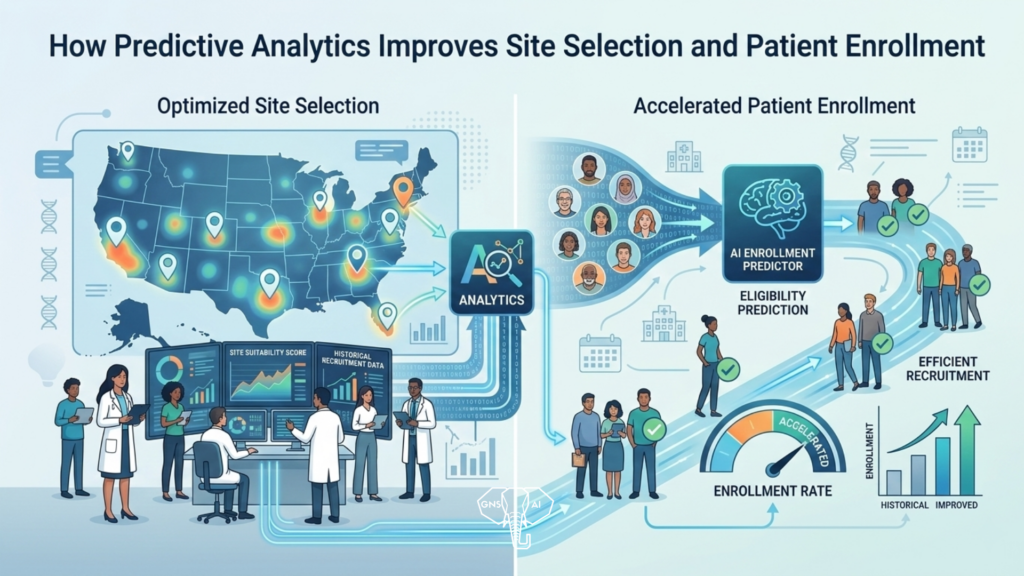
How Predictive Analytics Improves Site Selection?
Evaluating Historical Site Performance
The predictive models are models that determine the performance of sites under similar protocols, indications, and populations. Measures are enrollment consistency, data quality, speed of startup, and query resolution format.
This method brings forward credible sites that might not be top in terms of volume but presentable.
Assessing Operational Readiness
In addition to enrollment numbers, it evaluates workforce consistency, contests studies, and infrastructure preparedness. This will not overload the already strained, high-performing sites.
Robotic process automation healthcare guarantees automated data pipelines and keeps these insights more updated instead of updating them during the periodic reviews.
Forecasting Enrollment Timelines
Predictive models are enrollment curve simulators that are run with different assumptions. Scenario comparison before activating sites by the sponsors occurs as opposed to in-study adjustment.
This vision saves on expensive modifications and last-minute extensions of the site.
How Predictive Analytics Accelerates Patient Enrollment?
Identifying Enrollment Bottlenecks Early
Analytics indicate the areas where patients fail to screen or fail to provide consent. Teams step in before minor matters develop.
Matching Protocol Criteria to Real Populations
Predictive models match the inclusion criteria with the real patient demographics that are coined in EMRs and claims information. This diminishes overestimating qualified people.
This ability is compatible with robotic process automation in healthcare that simplifies the process of data extraction and normalization.
Optimizing Resource Allocation
Instead of allocating resources equally, analytics allocates resources to locations where the marginal investment produces the best result in the form of enrollment.
The Role of Automation in Scaling Predictive Insights
Predictive analytics demand the availability of precise information at the right time. Delays and errors are brought about through manual aggregation. Automation bridges this gap.
Robotic process automation in healthcare data ingestion, query monitoring, and reporting processes becomes a more crucial requirement in assuring consistency and auditability.
This platform allows analytics to be run using existing data instead of past snapshots.
Integrating Predictive Analytics Without Disruption
Organizations are reluctant to embrace analytics owing to what is perceived to be an overhaul of the system. Contemporary methods do not embrace rip and replace.
CTMS EDC EMRs and lab systems are linked together using virtualized data layers without data transfers. Analytics does not take part in the destruction of operational systems but rather takes in unified views.
Automation orchestrates data refreshes while analytics drives insights.
Governance and Trust in Predictive Models
Clinical trial predictive analytics should be transparent. Teams must have knowledge of the motivation behind forecasts.
Best practices Leaders develop model governance processes, version control, and validation processes. Human control is still in the center.
Analytics is a decision maker, not a decision taker.
This equilibrium favors controlled settings as well as facilitating innovations.
Business Impact of Predictive Site Selection and Enrollment
There is a noticeable improvement in organizations that use predictive analytics.
Timelines of studying startups shrink. The fluctuation in enrollment reduces. Burden surveillance will be reduced because high-risk sites will be revealed sooner.
There is an improvement in financial predictability as the forecasts move towards the actual performance.
These effects are multiplied over portfolios, not at an individual study level.
How Predictive Analytics Supports Strategic Trial Planning?
Beyond individual trials, analytics make the decisions at the portfolio level.
There is a comparison of region, therapeutic areas, and site networks across time by sponsors. Investment plans change according to facts and not custom.
Forecasting knowledge informs the development of protocol design feasibility and choice of vendors.
Challenges to Address Before Scaling Predictive Analytics
Information quality is still fundamental. Mixed-up definitions, fragmented histories, and displeased ownership weaken models.
The advantages of readiness assessments in organizations are the evaluation of data maturity governance and operational alignment.
Automation minimizes friction, and analytics demands commitment by the leadership.
The Future of Predictive Clinical Operations
Adaptive trial designs, decentralized models, and real-world evidence are becoming more a part of predictive analytics.
With the maturity of the systems, the analytics become prescriptive rather than descriptive.
Early investor organizations develop institutional intelligence that is hard to imitate.
Conclusion
Predictive analytics transforms site selection and patient enrollment from uncertainty driven processes into evidence guided strategies. When combined with RPA and AI in Healthcare, organizations move faster with confidence while maintaining regulatory trust. Sponsors CROs and healthcare innovators that operationalize analytics position themselves to deliver trials on time and at scale.
Transform your clinical trials with GNSai and unlock smarter site selection and faster patient enrollment.
Frequently Asked Questions
1. How does predictive analytics differ from traditional feasibility analysis?
Predictive analytics takes real-time and past data to forecast the result instead of using estimates or surveys, which are not dynamic.
2. Does predictive analytics replace site relationships?
No, it supplements relationships by bringing objective evidence to the decision-making.
3. What data sources support predictive site selection?
The most typical ones are CTMS, EDC, EMRs, laboratory systems, and operating measures.
4. How long does it take to implement predictive analytics?
Depending on the readiness of data, pilot programs usually provide information in 60 to 90 days.
5. Is predictive analytics suitable for small studies?
Yes, small studies enjoy the advantages of focused models, which minimize risk and enhance predictability.